
7 members enjoyed a dry, breezy and increasingly warm day at Blacktoft. We hadn’t got out of the car park before we had what some might regard as the best sighting of the day and that of a weasel carrying a prey item. Soon

Faced with 7 close onlookers, this little killer paused briefly before diving into the long grass
afterwards, and closer to the visitors’ centre, another weasel appeared carrying what appeared to be a youngster. However, a photo showed that this was not the case.
Initially we sat in the Reedling Hide where we had regular flight performances from Sedge Warblers, Marsh Harriers making food passes and occasional,

Male Marsh Harrier
brief sightings of Bearded Tits (Reedlings). Then on to Marshland Hide from where the Barn Owl could be seen through the doorway of its box, a Little Ringed Plover was spotted on one of the islands and a Water Rail was seen sneaking along the foot of the reeds.
With low expectations, we walked to the dried up Ousefleet scrape and settled down to lunch in the face of a dearth of bird life. However, things looked up when a vividly coloured Yellow Wagtail dropped in.

Yellow Wagtail – the photographer apologised for the quality of the photo but they were trying to eat their sandwiches at the time.
After eating, we headed for the most easterly, Singleton Hide with the hope of catching a Spoonbill. Sadly, the one that had been reported flying in that direction must have gone further on so with nothing new being seen, 5 of the 7 decided to make the 20 mile drive to Alkborough, visible from Blacktoft but with the river Trent in-between making it a 40 minute drive. However, our departure was delayed slightly with the appearance of a Great White Egret and a Reed Warbler just in front of the hide.
Alkborough – there are 3 hides here and we visited the more distant 2 involving a 3-4 km walk. The day had really started to warm up and with the increase in temperature, the butterflies were out in force, mainly Painted Ladies but also Red Admiral, Small Tortoiseshell and Speckled Wood. A Reed Warbler did a surprise appearance perched near the top of a reed stem where it remained for more than a few seconds but still too briefly for our resident photographer to untangle his different straps to liberate the camera. By far the most interesting observations we made during this visit were the small number of Wigeon (6) in one of the pools and the several hundred Barnacle Geese on the mud banks at the side of the Humber and in fields on the river’s southern shore. Surely they should have migrated to Scandinavia by now (but see below).
On returning to the cars, we found a couple of interesting caterpillars (photos) and saw a small flock of Linnets.
-
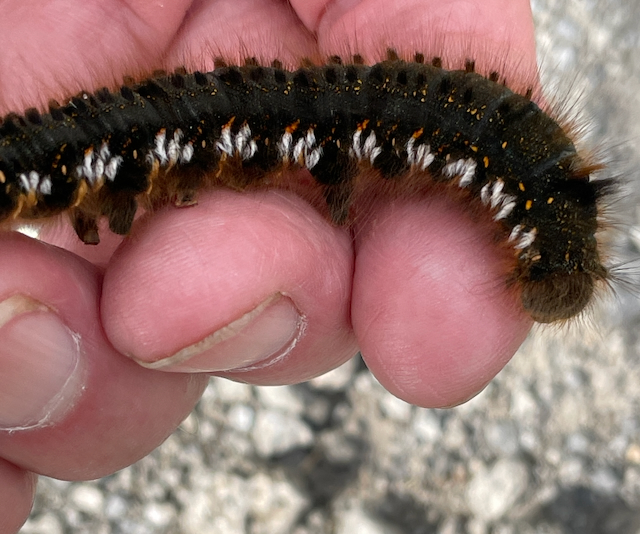
- Drinker moth caterpillar
-
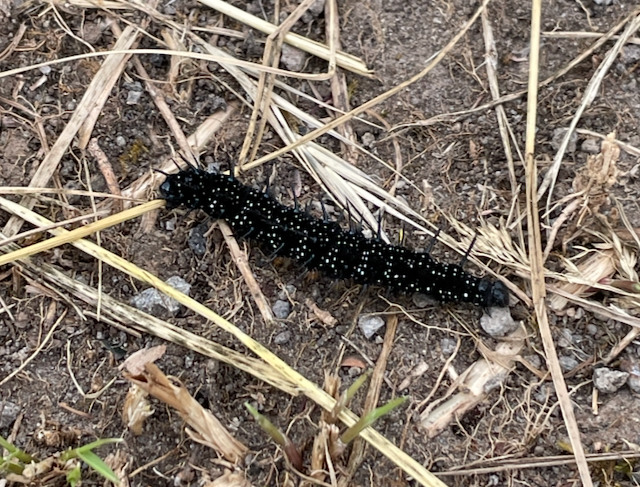
- Peacock butterfly caterpillar
All told, 50 bird species for the day and additional mammal and Lepidoptera interest.
Barnacle Geese – a bit of research revealed that in the UK, there’s a resident population of Barnacle Geese, mainly in England, of approx 5800 according to the 2023 census. Click the link for a brief abstract from the journal of British Birds, 2025 Vol.118: Pages 60–71 Resident
Photos thanks to Rob Simmons, Jayne Jankinson & Martin Kaye